
Home     Contact Us         Log in
Jul 03
Tuesday
Mandala Projects
The Sakyong Re-introduces the Ratna and Introduces the Lineage Medallion
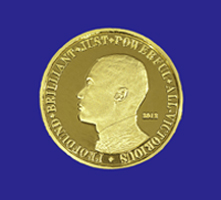
by Solomon Halpern, Ladrang Councillor
photos by Marv Ross

The Sakyong Jampal Trinley Dradul, Jamgon Mipham Rinpoche, has reintroduced Shambhala’s currency, the ratna, with the minting of the 2012 gold and silver ratna coins. Consideration had been given to the subject of re-minting ratna coins at various times over the years, as Shambhalians asked for them to be produced, however the conditions for a minting to occur never fully ripened until now.

As background, ratna coins were first minted under the guidance of the first Sakyong, Sakyong Dorje Dradul, Chogyam Trungpa Rinpoche, in 1983. These coins were minted in fine silver and 22 karat gold, in one ounce and 1/10 ounce size respectively. Sakyong Dorje Dradul’s shave-headed profile is embossed on the obverse of the 1983 coins. His profile is encircled by the text “Profound, Brilliant, Just, Powerful, All-Victorious”, which are the traditional qualities of a Sakyong. The reverse of the coin features the scorpion seal of the Sakyongs over sun-rays. The reverse also has “Ratna” in both English and Tibetan text written on it. Interestingly, the numinous aspects of these coins were their lack of a date and feature of a reeded edge.

The second minting of ratna coins occurred in 1991. At this time, only half-ounce fine gold (24 karat) coins were produced. These coins featured a younger Sakyong Dorje Dradul with a full head of hair on the obverse of the coin, along with the qualities of a Sakyong. On the reverse is the scorpion seal and seven peony flowers along with “Ratna” in English and Tibetan, as well as the year. These coins also had a reeded edge.

The artwork for both the 1983 and 1991 ratna coins was created by sculptor Joshua Mulder, from photographs by Blair Hansen.
The new ratna coins are the product of a little under two years of work coming to fruition. They are a melding of past and present. They are a cultural and artistic bridge for the lineage of Sakyongs and artistry of Shambhala. Observers looking at a set of all the ratna coins that have been produced will see the clear cultural threads connecting past and present.

The new fine gold (.999 pure) and fine silver ratna coins are both minted in one-ounce size and are appropriately viewed as bullion coins. The coins feature the current Sakyong Jampal Trinley Dradul’s embossed profile on the obverse of the coin encircled by the qualities of a Sakyong as well as the year, 2012. The reverse of the coin is exactly the same as the reverse on the original, 1983 ratna coins. In fact, for the new silver ratna coins, the very same die was used to press the 1983 and 2012 coins. The artwork of the Sakyong’s profile was again performed by Joshua Mulder, this time from a photograph by Christoph Schoenherr.

In addition to being religious and artistic additions to Shambhala culture, Ratnas foreshadow a future possibility – creating an economy that embodies the principles of Shambhala. It is exciting to imagine a community where ratnas are the currency in use, reflecting not just a value exchange based on a precious metal, but also based on the basic goodness that is inherent in humans and society.

The ratna coins were consecrated at the Kalapa Court in Boulder as part of a day-long puja, feast, and lhasang ceremony. When Sakyong Jampal Trinley Dradul purified and blessed the ratna coins he made aspirations for the health, well-being, and enrichment of Shambhala.

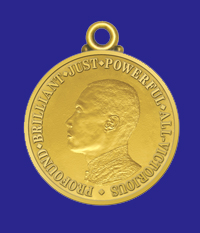
At this same ceremony the Sakyong lineage medallions were also consecrated. For the first time ever in our community’s history gold and silver lineage medallions have been produced for the warriors of Shambhala to wear over their hearts. Each medallion has a relief of the Sakyong Dorje Dradul on one side and the Sakyong Jampal Trinley Dradul on the other. Both reliefs have the qualities of a Sakyong surrounding them.

For order information and more pictures please follow this link:

sakyongladrang.org/Ratnas

May the lineage of Sakyong’s and Shambhala flourish and continue to create a culture of kindness and strength.

Be Sociable, Share!
Post Tags: , ,
30 responses to “ The Sakyong Re-introduces the Ratna and Introduces the Lineage Medallion ”
  1. Ah, just like the emperors of ancient Rome, coins with the image of the living king! And for a modest markup (click this link!) you can buy them for yourself. Suggestion for the next mint – engrave the coins with “In the Buddha we Trust.” It’ll be a big seller. The Buddha himself would have been much too humble to approve anything like that, but obviously he isn’t around.

  2. Lungs Hip Hop
    Jul 5, 2012
    Reply

    Come on Michael, get with the program!… Just imagine all of the goodies you’ll get when you “buy in.”

  3. Absolutely! I can use my Amex card and earn Rewards Plus points to buy even more cool merchandise. The gold medallion is cool, but I’m holding out for the pure gold elaborately engraved begging bowl. It will set me back a few thou, but is there really any better way to remind myself of simple humility and non-attachment, and impress my friends at the same time (they will be green with envy)? Ka-ching!

  4. Dragonball69
    Jul 5, 2012
    Reply

    I can incorporate these medallions into my next Magic: The Gathering meeting! The Scorpion King returns!!! I’ll have to borrow some money from mom.

  5. “The coins feature the current Sakyong Jampal Trinley Dradul’s embossed profile on the obverse of the coin encircled by the qualities of a Sakyong – Profound, Brilliant, Just, Powerful, All-Victorious”

    Unfortunately there wasn’t enough room for the quality “Humble”.

  6. All kidding aside, here’s a quiz for Shambhala “Buddhists.” Why were there no images or likenesses of the Buddha while he lived? Was it because he was humble and even as he died he made it clear he was just a man, not a deity to be worshipped? After all, earlier in his life he recognized the hollowness of the royal trappings that he had inherited through his bloodline. He walked away from them. If you disagree, do some research of your own and tell me how I’m mistaken. It was only centuries after the Buddha’s death that the images, statues, etc. began to appear. Sadly, logical insight and clear teachings never seem to be enough, whether it’s Jesus Christ or the Buddha. And being a mere man obviously doesn’t cut it. People want their deities and there will always be individuals more than willing to capitalize on this need and accept and encourage their own deification. Where does it end? Minting coins in one’s own honor, listing their “qualities” on the coin, and selling the coins at a huge markup, will be hard to top.

    Shambhala is supposedly about Buddhism, yes? Well, if that’s true, aren’t humility, equanimity and non-attachment principles to be taken seriously? Do YOU think that a self-proclaimed Buddhist “kingdom” that sells gold and silver coins to its followers, at a huge markup, bearing the image of the “king” (credit cards accepted!) is something the Buddha himself would support?

    Maybe you’re happy worshipping a king and royal family. Maybe you’re a westerner than likes to pretend being Tibetan. It’s so mysterious and exotic, isn’t it? Go ahead, be happy. You’ll never be alone. Groups with these characteristics always have and always will be around. Please, just stop saying you’re “Buddhist.” It degrades what he was all about. He was beyond such nonsense and I believe, through his actions, he hoped his followers would see the logic of his views (as opposed to blindly accepting it through faith). Obviously, this is just my opinion, but I welcome any dialogue, especially from SI leadership, to coherently refute anything I’ve said. I’m not looking for an argument, but when I see an abomination like this, I can’t be silent. Realistically, I don’t expect any response. It’s sort of like current political dialogue – look the other way when something you’ve bought into is being challenged.

  7. Hi Michael,

    I know it’s easy to look at things like this and be very critical about them. But honestly, I get the feeling that you’re shooting from the hip about everything you don’t like about materialism in general. There is nothing “shady” or “evil” going on here. There is nothing inherently wrong with having nice things, I believe buddhists generally over-react to material things.

    Chogyam Trungpa was a hugely loved teacher, and people are constantly honoring his life and teachings. Is it really such a big deal that somebody decides to make a coin? Are we “worshiping” him? No.

    And as for Americans trying to be Tibetan, this is something entirely new for us in this Country, we are trying to see where the pieces fit and see if we can actually create something genuine here, is it wrong that we are working with what has been handed down to us? Can we make something completely original out of something that is 2,500+ years old? Hasn’t Buddhism done the exact same thing and had an effect on every culture it’s been adopted in?

    One of the ideas in Shambhala is that we should fully live in this world and try to be of benefit, and Trungpa Rinpoche taught you should “take your seat” at the center of your world. This included managing money, having a job, being a business owner, etc. Fully participating, not going off and retreating from the world. He believed in the richness of the world, the inherent awake quality in everything. We have “courts” and a “king” and all other sorts of royal sounding things, because we believe in the basic decency of these forms. These things REPRESENT inner wealth and harmony. It may seem strange, but if you don’t like it, I’m sorry.

    As for this “huge markup”, nobody is taking this money and just pocketing it. We are completely non-profit and this money goes to support teaching activities around the world. I’m sure if you asked, you could find out exactly where the money is going. We are very transparent with our money that comes from program revenue and donations.

    I’m not SI leadership, nor do I even work for Shambhala, I’m a member of the U.S. Military stationed overseas, that has received tremendous benefit from the teachings and heart-felt interactions and support in the Shambhala community over the last few years.

    Have you even ever been to a Shambhala center or read a book by Chogyam Trungpa to see what we’re actually about before you go posting marathon negative comments?

    Others may be much more skillful replying to you than me, but that’s the best I can do right now.

  8. Hi Ben. I appreciate your comments. First of all, I am quite familiar with Shambhala and the writings of its teachers. (I’m a member of a center.) Secondly, I am not just “shooting from the hip” with uninformed opinions. I recognize, quite realistically, the challenges of “walking the walk and talking the talk” in today’s modern society. Obviously, the environment is different than it was 2,500 years ago when the Buddha walked the earth. That said, if a particular path, and the principles it espouses, have any real and lasting value, it can be applied and lived in any time. That is, it doesn’t have to be discarded because “today’s culture is different” (no kidding!). Should today’s Buddhists live lives of ascetics? Of course not. That’s not what the Buddha taught. But should they mindfully step back, look at their own practice and, by definition, the practices of the Sangha to which they belong, and ask if they are consistent with the principles they supposedly follow?

    I was born a Catholic. I’m quite familiar with the Bible (New and Old Testaments) and the teachings of Christ. When I visited Rome a few years ago, I toured the Vatican. Up to that time, I had never questioned whether or not its existence was consistent with Christian teachings. When I saw with my own eyes the previously unimaginable riches within, while homeless people resided outside the gates, I understood that something was very wrong. Does the Catholic Church do good things for people? Of course. Are there well-meaning members in its leadership? Of course. Nevertheless, over the centuries, has there been a growing disconnect between the teachings of the Church (Christ’s teachings that is) and its practice. You bet! One can believe in the basic teachings of the Church and still be critical of the path it is taking. I feel the same way about Shambhala. When I see things like these coins (which look almost EXACTLY like the coins Roman emperors issued honoring themselves – check it out), I’d rather say something about it than just rationalize it away.

    History is filled with examples of countries and religious groups, etc., founded on solid principles, that slowly drifted from those principles, a little at a time. I apologize for the sarcastic tone of a couple of my comments (NOT the last one though). But it saddens me to see people just accept, without question, whatever is done. If you think my observations are over the top, I simply ask you, and everyone else that calls him or herself a Buddhist, if the Buddha himself would have embraced the practices that I’ve been criticizing here. If you honestly consider the example of how he lived his life and conclude that he would have embraced such practices (e.g., a gold coin extolling his virtues), then we agree to disagree.

  9. Ben, one point I forgot to include. You opened your note by saying “I know it’s easy to look at things like this and be very critical about them.” My whole point is quite the contrary. In organized groups, its always easier to look at things and NOT be critical of them. Just to go with flow and not question.

  10. LeOSullivan
    Jul 6, 2012
    Reply

    Dear Michael,

    I suggest you may rest easy, assured that 99% of us Shams wont be burdened with these.

    So the *bling* jolts our anti-/ materialist conceptions.
    But shall I begrudge those with a more glamorous ride thru The Kingdom?
    I meet the most genuinely helpful- and the most boundlessly empty people in life inside Shambhala.
    The whole idea of dharma is to become both helpful and boundless.
    This path seems to help us, the closer we get to it.
    And people, sometimes, seem to take just those steps that they can.

    But check this: SI can offer help to everyone interested, regardless of station.
    With no obligation..
    And with (generally) little condescension towards
    those who ‘cant afford’ full-time, full-price fandom.

    Some of that jolt could uplift someone you know, from local MIs and Acharyas to land-center hands, through central operations, new online collections, bandwidth, grants and numerous peripheral benefits.

    Dear Ben,
    As ‘The People of the Golden Key’ we thrive in generosity, and so of course it’s fair to say that financial contributions to SI do support public ‘teaching activities’ – in part. However SI funding campaigns tend in part to evolve in response to need, so precise proportions can vary widely per campaign.
    But… I know some Directors would love a volunteer with a commitment like yours, translating living numbers… Want a hard job?

  11. If this offering offends anyone, they should not participate. If we understand that the mandala is in need of financial assistance and would appreciate a reminder of our teachers, then, by all means, let us support the glorious activities of the Sakyongs by purchasing these coins and medallions.
    Ki Ki So So!!

  12. Ki Ki So So Ka-ching! :-)

  13. I love Shambhala deeply but at a moment when so many brilliant and inspiring voices in the global consciousness movement are questioning the shelf-life of the very paradigm of currency itself, creating a new one seems to mark a potential divergence between Shambhala, Inc and all those other flowers of enlightened society sprouting up independent of our relatively small organization. In other words, I see Shambhala wisdom and enlightened society deeply manifest in, for example, people working towards gift and barter economies and these medallions feel rather retrograde in comparison. Despite my devotion, I have much more faith in a gift based economy than even the most enlightened monarch’s coinage. I wonder how Shambhala intends to work with others in the global consciousness movement? By recognizing and fostering ES wherever it occurs or by trying to bring its denizens into “our” fold?

  14. Stephen Mathiasen
    Jul 9, 2012
    Reply

    The introduction of coins as a cultural offering worries me, and makes me a little sad. When taking into account the importance with which the Sakyong place emphasis on making a contribution to the larger society, I think this offering is a strange prioritization. What is the chance of making a powerfull impact on society, if we as a community, ignore the dialectic proces of coming in resonance with it? Will this offering of coins be stepping stones for communcating the core values of shambhala to others? Regardless that the offering is an internal offering, everything the shambhala community creates on the open “scene” will have an impact on how we as a community are looked upon. And how we are looked upon are determining factors for being able to act in accordance with what we are aiming for on a larger scale. There can be many obstacles in this process, unfortunately we ourselves are making a contribution to these with this offering. Stephen Mathiasen, Copenhagen

  15. PS : I should’ve added – in the experience of indigenous peoples, the (oft-times forceful) introduction of a new currency has often been one mechanism of cultural genocide. Obviously I’m not worried that such a thing is happening here. But the subtler association of violence and currency seems, to me, worthy of careful consideration whenever a new form of money is created.

  16. This news stopped my mind. Into the gap, unbidden, came the phrase: “jumping the shark.”

    I might have taken this differently a year or so ago. But after seeing my local Shambhala center suffer badly, pretty much fall apart, this seems spooky and odd to me. That Shambhala center went from a warm, open, friendly dharma-Buddhist-Shambhala scene, to one dominated by a hard-line cult-of-personality Sakyong-or-nothing sort of crowd, one with a more narrow focus and only conditional friendliness. The condition is: it’s all about the Sakyong, 100%.

    Personally I think the Sakyong is fine, wonderful. However, the cult-of-personality quality seems to be nothing but damaging, and nothing like Buddhist. I’m not interested in that. These medals seem to echo that shift in the culture to me.

  17. From Wikipedia, RE: Roman coins (to which the Ratna is nearly identical):

    “The imagery on Republican coins wasn’t meant to influence the populace; the messages were designed for and by the elite.

    The imagery on coins took an important step when Julius Caesar issued coins bearing his own portrait. While moneyers had earlier issued coins with portraits of ancestors, Caesar’s was the first Roman coinage to feature the portrait of a living individual.

    Coins often attempted to make the emperor appear god-like through associating the emperor with attributes normally seen in divinities,

    To aid in succession, the legitimacy of an heir was affirmed by producing coins for that successor.”

  18. Hopefully, some of the input here will be taken seriously. I think it’s a sign of strength to be able to say “whoops” and reverse course. And this was a big whoops, presuming the principles of humility and equanimity are more than mere words. On the other hand, there are probably even more folks who say that the whole coin thing is just fine, that if you don’t like it just don’t buy it, that it’s no big deal, let it go. But that doesn’t make it right. You don’t have to look too hard at all in history to see examples of how the majority might simply follow without question and surrender their principles in doing so. I’m hopeful that 1) people will look at this objectively and see why it was the wrong path and say something about it (criticism can be constructive) 2) that leadership will demonstrate strength and humility by changing course. There are few more powerful signs of principle than leaders that listen to criticism and act on it when appropriate.

    If that doesn’t happen, then I’m afraid that Jon’s observations (and I’ve seen a similar trend in my own center) are actually applicable to the whole Shambhala organization. And that would be a very sad thing indeed. Be brave leaders, stubborn pride isn’t what Buddhism is about. Act!

  19. Dear friends,

    what an interesting point Michael has made.

    At first I was blindely attracted by the gold coin, Ratna by nature, then a feeling of some sort of ‘ick’ took place and wanted to get rid of it, but wait a moment.

    All these feelings are quite an interesting energetic scenario to work with. Easier to be said than to be done.
    In such over-materialistic age we are living in, we got even a gold coin! It is almost humorous.
    So working with these feeling of greed-claustrophobia within the Mandala can help perhaps growing clearer about them where the situation can be more compelling.

    Regardless the intention of the Sakyong, these emotional juices are challenging and useful to work with, or at least to contemplate, whatever the outcome of such work and contemplation might be.

  20. I don’t understand why it was okay for Trungpa to do this but not his son in the same role. He’s obviously not making it up – the first Sakyong started it. Was it a mistake then? Or a cult of personality then?
    Why is it now?

    Personally, I think the issue of commodity money, even if only as a symbolic gesture, is a nice counter to the corruption happening in the global monetary system. Fiat currencies are right at the root of many of our problems because they are based on debt.

    Buddha taught King Indrabhuti, who did not want to relinquish his kingdom. Indrabhuti attained enlightenment and led his kingdom well. Shambhala is based on monarchical principles. That makes us uncomfortable – I certainly feel it. But I do think that it’s a non-negotiable aspect of this lineage. It is the heart of it. If you hate that aspect and can find no virtue in it, then it probably is not your lineage.

    Are these prices high? According to the current market, yes. Historically? less than you might think. Also, it’s easy to disregard cost of minting and so forth. I can understand the cynicism, but I really don’t see why re-upping one of Trungpa’s programs is bad, especially at a time when the global financial situation is so precarious. A kingdom needs a currency, even if it’s mostly symbolic- for now.

  21. Kelly – yes, it’s a cult of personality now AND then. CTR was before my time, but I would have reacted in the same way if it hadn’t been. And sure, there were monarchs that were taught by the Buddha. But that was 2,500 years ago, when such a form of rule was the norm. I think the Buddha was wise enough to see the benefit of bringing Buddhist practice, to the extent possible, into his world. And if that meant ruling monarchs, so be it. Nevertheless, the fact is that the Buddha himself rejected his own royal lineage. That we have so-called Buddhists “leaders” in the 21st century donning the robes themselves, welcoming the royal treatment, and doing everything they can to continue the “royal lineage” is not, IMHO, something the Buddha would have encouraged. Times change. This isn’t ancient India. The beauty of Buddhism is that it can (well, at least is COULD) propagate and flourish in any environment and system. I really don’t think it’s about holding on to ancient cultural traditions (that just happen to benefit a royal few.

  22. And the idea that this is a “kingdom” that “needs” a currency is just plain silly. If Shambhala’s purpose is to bring the benefits of meditation practice, as well as the Buddhist principles of compassion (among others), to as many people as possible, isn’t that enough? I guess not. Too modest and simple a goal? Apparently. That Shambhala pretends that it’s a real government in the same sense as other sovereign politically organized governments on this planet, with its own security wing (kasung? give me a break!), seat of “government”, etc. is make believe of the most juvenile kind. I joined my centre because I believe in the benefit of sitting meditation and had a desire to learn more about Buddhist practice. That was a beautiful thing. The whole personality cult thing is an abomination of Buddhism, but not at all uncommon, especially when there’s a buck to be made. Go ahead, buy those coins. And when you look at them, ask yourselves why the coins aren’t engraved with the image of the Great Eastern Sun and the words “compassion” and “equanimity” instead of a living person and his attributes (of which humility is blatantly absent).

  23. FWIW, my partner made a post here with a handful of quotes from Wikipedia about Roman currency. Because the basic form of the Ratna is nearly identical to Roman coinage. A profile of the “ruler” with a circular-shaped set of attributes describing (and crowning the head of) that ruler. She wanted to illustrate a similarity and so to provoke questions about what this development signifies. The post was not approved by whoever moderates Shambhala Times.

    When an organization makes an action that appears profoundly cult-like and questionable, one would hope that organization would be prepared to rigorously and wholly engage their critics, detractors and those otherwise suspicious. OTOH they also have the option of proudly rejecting such posts and catering to those who are delighted they have been offered yet another Shambhala product to own.

    I’m fairly certain I see which you’ve chosen.

  24. I ordered a medallion. I am not a huge intellectual who has thought about all the ramifications of these offerings that you guys have all been talking about. I am simply a Shambhalian who is trying to live my life as cleanly and honestly as I can, and when I saw the email come through about the coins I thought it was a good idea – give money to the Sakyong, and I get an item to wear over my heart that every time I feel it – it reminds me that I am here on earth not just for me but for the benefit of all beings.

    That is as far as my thought process went on the medallion before I ordered it – I could afford it, so I bought one.

    I was also brought up Catholic like Michael was – sent to church every Sunday by my parents – so I am familiar with all the rituals and items that go along with being religious, and for me – I have to say – that is one of the things that drew me to Buddhism. I love the tschotskes. Is that a bad thing? Will it keep me from becoming elightened in one lifetime? Maybe, but there’s probably a lot of other things that are going to do that as well – but at least I’m trying.

    We are all at different levels on the path, and the level that I’m at thinks the medallions and coins are just fine. I am vibrating at a low level I guess and I need a lot of reminders, and I’d like to thank the Sakyong for providing me with one more.

  25. Dear Matt,

    Sarah, the editor, is away on retreats for the next month and I am one of the people helping maintain the site. A handful of people have different roles, but it might be that no one was charged with keeping an eye on the comments, because there were a bunch awaiting moderation. So, I just went in and approved them. It wasn’t a conspiracy to prevent dissent on the article. Which, after all, should have been evident by the appearance of all of “michael’s” comments. :)

    I’ll keep an eye on the comments from now on.

    Cheers,

    Travis

  26. Kristine McCutcheon
    Aug 8, 2012
    Reply

    I love the idea of floating a currency. I would rather give gold or silver as a teaching gift (I pay a premium when I buy it at the bank also – here I know where my premium/mark up is going) so I get to donate twice.

    If the Euro goes the way of the Dodo – maybe bullion is not a bad idea.

    I think it would be nice if we also made some more practical denominations. Here is to the copper Ratna!

  27. Kristine McCutcheon
    Aug 8, 2012
    Reply

    and the coins still have value!

  28. Steve Hirsch
    Aug 26, 2012
    Reply

    I have a handful of the original 1983 minting of the Chogyam Trungpa Silver Ratna coin and I am interested in selling them. Please contact me knshirsch@yahoo.com if interested.

  29. “We don’t see things as they are, we see things as we are.” — Anais Nin

  30. This is a much belated apology to Travis because I do very much appreciate that my partner’s aforementioned comment was approved, if in a belated way due to the distributed responsibilites of contemporary content moderation. Apologies and thank you!


Post a Comment


All content and source © Shambhala International (Vajradhatu) | Website Development by Blue Mandala using Wordpress MU.
Shambhala, Shambhala Meditation Center, Shambhala Training and Shambhala Center are registered service marks of Shambhala International (Vajradhatu). Way of Shambhala is a service mark of Shambhala International (Vajradhatu).